Thursday, March 17, 2011

40 Days of Lent: Day Nine

Godspell's Probably Inadvertent But Nonetheless Subversive Demonstration Of The Religious Impulse

I've always had a soft spot for Godspell, the musical retelling of the gospel of Matthew done as children's theater. The songs are either undeniably catchy or touching, whether or not you agree with the words. The nonstop mugging of the cast gets on my nerves, but it's balanced by beautiful shots of a depopulated New York City. The Last Supper scene always gets to me, more for its depiction of someone saying goodbye to friends he'll never see again rather than for any New Testament reasons.

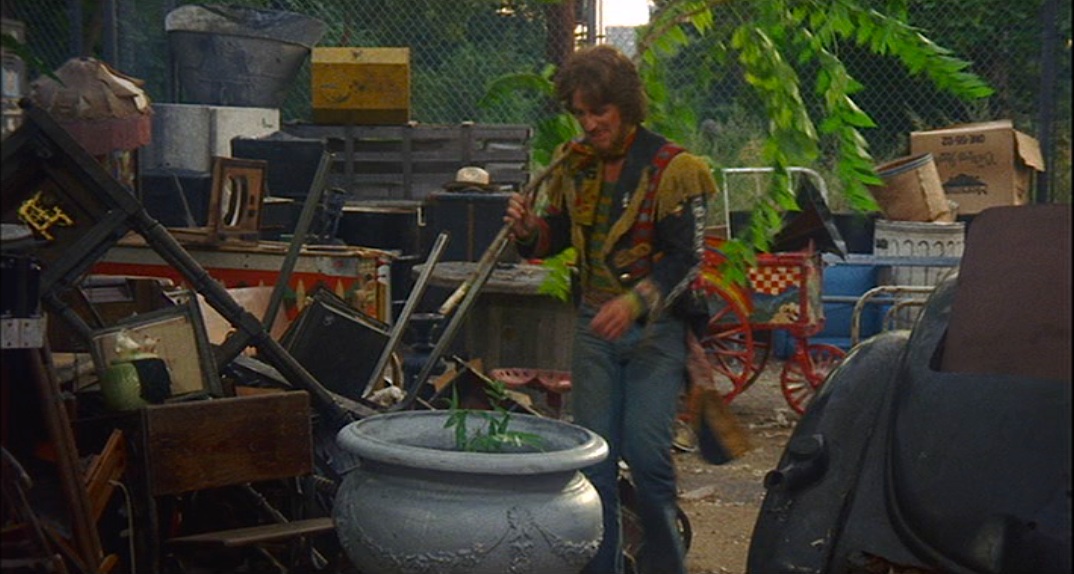
However, last time I watched Godspell a little bit of business went by and I thought "Did I just see what I think I saw? They couldn't possibly have meant that the way I'm interpreting it." It is, in just a few seconds, an effective demonstration of the religious impulse, almost a parody of said impulse.

It's about 24 minutes into the movie, during the comedy bits that follow the song "Day By Day." The disciples are cavorting in a junkyard (which is a sentence I can't imagine ever writing again) when we see one of them plant a small twig.


Jesus then comes by and waters the twig.


Unbeknownst to the first disciple, another disciple comes along and replaces the twig with a young tree.


The first disciple, while ignorant of the perfectly normal explanation of what has happened, is amazed at this "miracle."


Rather than look for any logical or natural reason for what occurred, she attributes it to Jesus and His magic...


and becomes His follower.


As mentioned above, I don't think this was intended as anything more than comic business. While this is happening, the other disciples are painting each other's faces and playing with a beat up car. Nothing else in the film is as subversive, but it's hard not to see this little vignette as an example of someone becoming religious because, in their ignorance, they attribute to a god or religious leader something that's actually part of the natural world.

Wednesday, March 16, 2011

40 Days Of Lent: Day Eight

Karma

When I'm keeping my hair short, I go to a cheap barbershop and tell them to sse the #6 guide on the clippers and that it's just like mowing a lawn. However, whenever I decide to grow my hair a little longer, or to be more accurate, lumpier, I go to the rockabilly themed barbershop that's about a half hour's walk from my apartment. I make an appointment with D. and I'm usually happy with the results.

But there is a twist. With D., the longer you can keep him engaged in conversation, the better the haircut you get, so it's best to come prepared with a couple of topics to discuss. I hadn't realized this until one time D. was either talked out or not in a social mood. Then my haircut consisted of clip-clip-clip okay you're done. That's it? Yeah, that's it.

Beyond the obvious benefit to my coif, I enjoy talking with D. for as long as possible because he's an entertaining conversationalist. He once swore me to secrecy before telling his idea for a novel. Upon hearing the idea I regretted my promise and wished I was the sort of person who stole ideas. It was that good. Another time, his story of the police trying and failing to arrest a local drug dealer slowly evolved from "guess what happened in the neighborhood today" to a great unfilmed Keystone Kop misadventure. "He looks like...Stan Laurel" D. said of the drug dealer, an image that still makes me laugh.

So while getting my hair cut last week, I was able to keep D.'s attention for a good long time with stories about my recent trip to London and Paris. "You took your mom? That's so sweet! I'd love to take my mom and dad on a trip overseas, but one at a time, thank you. Not together."

This seems to be the definition of karma: do something nice like take someone on a trip and the universe rewards you with a better haircut. On the other hand, last time I saw my sister, she asked "Did you get a haircut?" Hearing yes, she looked it over before asking in earnest "Did you do it yourself?"

Tuesday, March 15, 2011

Monday, March 14, 2011

40 Days of Lent: Day Six


Want to check your email but you got your period? No problem!

Seen near the Pompidou Center.

Sunday, March 13, 2011

40 Days of Lent: Day Five

My mother had promised her hairdresser that she would bring him back a pack of French cigarettes. He didn't request any particular brand, just wanted French cigarettes.

While wandering underground through the maze of shops and less important artworks near the Louvre, we spotted a tobacconist that also sold tickets to the museum. Two birds, one stone. While buying my ticket, I asked if I could also have some cigarettes, pointing to a pretty white pack among the many choices on the wall.

"Which one?" the clerk asked.

"Le 'Fumer Tue,' s'il vous plait."

"Pardonnez?"

Thinking I was mispronouncing the name, I repeated it and pointed. "Non, non, le Fumer Tue...les blancs...ah, oui. Merci."

While ringing them up, the clerk said in English "Do you know what 'Fumer Tue' means?"

"Non, non."

"'Smoking Kills.'"

It wasn't the name of the brand, it was the blunt warning on the pack. So yes, I stood in front of a line of people wanting to buy tobacco and kept repeating "Can I have the Smoking Kills cigarettes? No, not those. The Smoking Kills ones. Yes, thank you."

Saturday, March 12, 2011

40 Days of Lent: Day Four

I like gargoyles.


From Notre Dame and Sacre Coeur.

Friday, March 11, 2011

40 Days Of Lent: Day Three

Woke up this morning to news of an earthquake in Japan, one of the largest ever to strike the islands, and attendant news and concerns about resultant tsunamis. It's seems unseemly to be writing or even thinking in my customary cheery way, yet that's how I feel. Things are not just going okay, they're actually going well. I don't hate my job, my current living situation is one of comfort, I certainly don't want or need for anything, my outlook has been upbeat. Maybe there's a certain naïveté to my current state, but lurking at the back of my mind is the awareness of how it can all change, the speed with which everything can go wrong. But until that happens, I'm going to appreciate things being good for as long as it lasts.

One of the people I work with is a bit of a Chicken Little. In 2008, when the stock market began to slide because of the overvaluation of e housing market, he ran around the office in a positive panic, just barely stopping short of predicting that soon we'd be eating our young. It was an entertaining experience. I was so enchanted watching his meltdown that I didn't even pause to worry about the fact that our economy might be imploding and we might be heading into a new depression. I find the era and the culture of the Great Depression fascinating, but that doesn't mean I necessarily want to live through one. After news of yesterday's disaster, he went online and found a wealth of information about the possibility of tsunamis striking the east coast on a website called Armageddontome.com. Basically, if a giant wave heads towards the NYC area, we'll have time, but not nearly enough, to get to safety.

Even this news didn't alter my mood. I know I'm going to die someday, but for some reason, I just get upset about that fact.

Thursday, March 10, 2011

40 Days Of Lent: Day Two

Telling my friend Bob the previous story, he commented that Paris has been having a huge problems with gypsies, which could account for the man's overreaction (my opinion) at the ATM machine. Happily our only direct encounter with people I assume were gypsies was not that bad at all.

We were making our way along the Seine when a woman in front of us held a gold ring out, saying she had found it on the ground. Perhaps it was my mother's? Maybe she had dropped it on the ground? My mother said no, not her's and then immediately said she was worried about whomever it was that had lost their ring: what an awful thing to happen while on vacation.

My mother said the woman should keep the ring as we had no idea how to return it to its proper owner. But the woman insistently gave the ring to my mother and rather than argue, we said okay and were on our way.

We had walked about four steps before the lady called to us and rubbing her fingers together in the universal sign for money, indicated she wanted us to give her money for the ring. "Oh...." we said, catching on to the scam. We handed the ring back to the woman with an unspoken attitude of "nice try" and resumed our walk.

Crossing a bridge, we saw the woman again, surrounded by some companions, one of whom bent over, placed a gold ring on the ground and then picked it up. This woman made her way towards us holding out the ring. "Nooooo...we just did this with her!" I said, gesturing to the first woman and laughing at how lackluster their scam seemed. Happily, both women laughed too, in a friendly way,nas if to say "Oops! Silly us!"

Wednesday, March 09, 2011

40 Days of Lent: Day One

Ash Wednesday!

First day of Lent and getting ashes smeared on your forehead is one of my favorite religious rituals. The enthusiasm that John Doe brings to singing about the Fourth of July is almost, but not quite, how I feel about Ash Wednesday.

-------------------------------------------------------------

Last Tuesday, after arriving in Paris and enjoying a good lunch at a bistro across from the Gare Du Nord train station, I found myself doing a quick dash among unfamiliar streets in a desperate search for a bank with an ATM. I had booked a flat from a remarkably laid-back landlord who had waived both the security deposit ("I don't need it") and 1/4th of the rent ("you can pay me in cash when you get here"). I had most of the rent in British pounds but was hoping to exchange it at a place with better rates than the kiosk at the train station. But apart from the more touristy locales, Paris is not over-run with places to exchange currency. Plan B: find an ATM and withdraw the rent in Euros while my mother waited in front of the apartment with the luggage.

I jogged along, thinking that eventually I had to run across a bank. I later found out that at the end of the first street, had I turned right instead of left, I would have found several banks a block or so away. But I am by nature gauche so it took me a little longer to find a bank and when I did, I was greeted with a sight like something out of a Michael Haenke film.

A pretty woman (there are no other types in Paris) was standing at the ATM while her male companion was roughly shoving two small children, running interference and keeping the children at arm's length from the woman. From what I could see, the children were not aggressively begging; they were just sort of standing there, looking unwashed and sad like ghosts from a Henry James short story.

How was I going to react to the situation when it was my turn at the ATM? It became a moot point, as the kids had silently disappeared by the time I began punching in my code. Didn't see them at all during my quick jog back to the apartment.

Sunday, March 06, 2011

Letter Of The Law, Rather Than The Spirit

While I was in Paris, I saw some girls wearing a ḥijāb, the traditional Muslim head covering. But one girl in particular stood out, because in addition to the head covering, she was wearing the tightest blue jeans and the spikiest heels I had seen in days. She almost looked like the result of one of those children's books in which the pages are cut and you can mix and match tops and bottoms. I wonder if the look was the result of a compromise with her parents. It was the best illustration of East and West, traditional and modern, and the religious and secular worlds I had seen.

Saturday, February 26, 2011

London

As with most trips I've taken, getting out of town is the worst part. I'm not referring to rushing through the airports, the inevitable patting down or fumbling attempts to get all your carry on electronics back in your bag with one hand while slipping on your shoes with the other. I'm referring trying to maneuver through New York City's subway system with a piece of luggage. Those who complain about the inconvenience of heightened security at airports have no idea what it's like trying to squeeze onto an elevator at a subway station with a large bag, only to be confronted by people who will not move to accommodate you because they hope that you'll get off instead. Oy. See ya, New York assholes. Won't miss you at all.

I should compare this to the fact that my mother, with whom I am traveling, was offered a seat on every subway today, save one. I was even offered seats next to her when people saw that we were together.

This Yakov Smirnovesque "in my country this, but in this country that" is an inevitable effect of traveling and being an Anglophile, it's easy to guess which side of the scales are loaded with gold and which have lead. Another effect is feeling like I'm in a dream: everything is familiar yet slightly different. Houses and buildings look different, so many made with incredible red bricks, and you imagine that cars move differently. It's been 15 years sine I've been here, but this morning, on the tube of all places, it all came back to me, not as distinct memories, but as sense memories, as emotional impressions of what it was like to be here and I felt so happy my eyes watered.

Wednesday, February 02, 2011

The Wave

The Wave: In Pursuit of the Rogues, Freaks, and Giants of the Ocean
Susan Casey

What's the matter, John? Blue Meanies?

Newer and bluer Meanies have been sighted within the vicinity of this theater. There's only one way to go out.

How's that?

Singing!

It’s a great ending to Yellow Submarine, and if you think of the “Blue Meanies” as the giant unpredictable waves becoming more and more prevalent in the oceans due to global warming, you can substitute “surfing!” for “singing!” and you’ll have an idea of half of Susan Casey’s book. As waves became bigger, surfers like Laird Hamilton have adapted, creating a new kind of surfing in order to ride 60 and 70 foot waves, which are too powerful and far from the shore to paddle to. Now a surfer is towed by a jet ski and positioned on the water to catch previously unobtainable waves. The risk is much greater that far from shore. Experienced surfers have drowned. The book contains a description of a particularly gruesome accident with a life-saving rescue by Hamilton, who hotwires a stalled jet ski with pair of iPod earphones and uses his wetsuit as a tourniquet.

In contrast to surfers with their spiritual quest to experience great waves, there are the other stars of Casey’s book, the scientists who try to understand the water and predict its behavior.

“Well, it’s not oceanographers looking at them anymore. It’s physicists! Because they’re discovered that these waves are behaving in a manner that is similar to light waves. They can suck the energy from both sides and concentrate it in one spot. And light waves are partially particles and partially wavelike. It’s moving [the study of waves] into a whole different dimension.”


The nature of light has been one of the conundrums of physics, because sometimes light acts like a wave and sometimes it acts like a particle. The idea that the water in the ocean may be the same way underscores a point made throughout the book: we really don’t know very much about the ocean. With global warming, the little we knew may no longer be true. For years sailors told stories of enormous monster waves in otherwise calm seas. Such tales were dismissed as physically impossible. Now it seems that they were happening and may become more of the norm.

A statistic is repeated several times in this book: on average, two large ships are lost at sea every week. The fact that this statistic is little known, let alone a source of widespread outrage, says a lot about how much we take for granted in a global marketplace. One of the effects of living in a technologically developed country is that you assume things are stable; in fact you come to depend on it. The chaos is kept far away; others have to deal with it. The people Casey interviews are all dealing with the chaos in various ways. Some try to understand it and others try to ride it, if for only a few moments.

On a slow day at work, slow because of a snowstorm the previous night (speaking of chaotic nature), I lent The Wave to our receptionist. At the end of the day, she returned it to me, saying that it was scaring the hell out of her but she couldn’t stop reading it and she was going to have to get her own copy. A perfectly succinct review.

Monday, January 24, 2011

What Was In The Package


Nunzilla!

The package was from my friend Elizabeth and contained a Christmas card and Nunzilla!, another "thank you" for letting her stay in my apartment during a recent visit to New York.

In the name of fairness, I should point out that the post office manager quoted in the previous entry was not trying to be difficult. He was trying to be helpful, short of the one thing I needed him to do, which was give me the package.

The postal system is in trouble for the same reasons as record companies and dvd stores are. They have a huge infrastructure set up to deliver less and less media to fewer customers. The infrastructure was put in place to deal with a much higher volume than is currently shipped. I can remember just a few years ago we used to get two large plastic bins full of mail every day at work. It took one of the assistants the better part of an afternoon to sort it all. The fact that the he liked to take his sweet time and peruse whatever magazines and catalogs came in is only partially relevant. Now our daily mail fills about half of one bin and the items being sent don't ever seem particularly important.

I have mixed feelings about the post office. I only go when work compels me, mostly to drop off certified mail. The post office we use inevitably has a long line, yes, but otherwise seems well run and the people who work there are pleasant. It's the opposite of the post office we used to frequent which seemed to be deliberately living up to the stereotype of unhelpful arrogant bureaucracy. Rules changed arbitrarily, without warning and never to the customer's advantage. It was staffed by people who were, in a word, assholes. The postal workers at the counter talked and joked with each other but didn't hid the fact that you were interrupting their chatting time. I did get to have a heaping dose of tasty schadenfreude when, in the wake of anthrax being discovered in the mail shortly after September 11th, I went to the post office and saw the formerly obnoxious staff wearing breathing masks, goggles and plastic gloves. They seemed fairly tense and very unhappy, which is good.

My grandfather Hanlon worked for the post office. (In a nice bit of contrast, my other grandfather worked for the phone company). The stories that have been passed down, of employees who could tell just by feeling an envelope if it contained cash, have given me a certain mistrust of the service, which is odd because I think the service is probably as good now as it has ever been. Various frustrations aside, getting something unexpected in the mail is one of those little pleasures I will miss if it's ever gone.

Look how well Nunzilla! gets along with the others in my black and white collection.

Thursday, January 20, 2011

P Off

Included with my mail yesterday was a crumpled card, dated the day before, informing me that I had something at the post office that the mailman was unable to deliver and that I needed to pick up. Looking at the card I saw my local post office was open till 7:00pm. I had time, why not go?

But when I get to the post office, a sign in the window says they are only open until 5:30. The doors were locked but a guy on a bicycle by the front door explained that one of the managers would occasionally unlock the door and help people, "but I don't know if he'll help you."

When the manager came to the door, I showed him the card and asked if I could pick up my package.

"No, we're closed. You'll have to come back."

"You can't just get my package for me?"

"Well, I can tell you if it's here, but I can't give it to you. We're closed."

Showing him the card: "It says you're open until 7:00."

"Those are old cards. We close at 5:30 now."

"Um, are you going to get new cards?"

"We have them, but we're not allowed to use them until we use up all the old cards."

"Okay, can I have the package rerouted to another address?"

"No, you can't do that. But you can have the package redelivered to your apartment."

"But I'm not at my apartment when the mail comes. That's why I'm here now."

"Can you come before 5:00?"

"I'm not taking time off work to come pick up a package."

"Saturday? We're open Saturday. Can you come then?"

---------------------------------------------
I don't know what the package is, but whatever it is, it better be pretty spectacular.

Monday, December 20, 2010

Tuesday, December 14, 2010

Recent iPhone Photos


By "recent" I mean "taken within 2010."

Monday, December 13, 2010

The Year In Status


While I am not a fan of the way that Facebook has cannibalized the internet, it has been good for some things. Friends can post pictures once so others can check at their leisure. It has also unleashed people's creativity, albeit in bite-sized doses. For all the Facebook apps that I want nothing to do with (Farmville, Mafia Wars, etc) there's something clever like the above: a random overview of my status updates for this past year. It's particularly handy, given the fact that I often can't remember what I've done last week, let alone for the last year, so reactions like "When did I see Fountains of Wayne?" are not surprising. What is surprising is how many of these posts deal with death, either directly or subtly. On the other hand, anyone who has perused this blog might notice that the only time I have anything to say is when I want to say "miss you."

Friday, November 19, 2010

My Poster for One Sheet Redux Show Currently at Maxwells


Originally I was going to write quotes from the film's omnipresent voiceover on the various leaves but decided I liked the image as is.

Many thanks for Henri Rosseau for painstakingly fashioning his unique views of nature so that I could come along a hundred years later and make a collage of them.

Wednesday, November 10, 2010

Catching Up


I have a piece in this show - it's the first time in a long time I've made anything. Best of all, I'm fairly happy with the results. The theme of the show was artists creating new posters for existing movies. Eventually I'll post my poster here online; for now you can see my interpretation of Terrence Malick's The Thin Red Line, along with other good work, at Maxwell's, 1039 Washington Street, Hoboken NJ.

Nice write up about the show here.

----------------------------------

Other doings:

I've been posting semi-regularly on 7NOW!, random, subjective, opinionated, at time ornery lists of seven items. Since I don't usually detail my current faves on this blog, 7Now! is a good spot to see what I'm listening to, reading, watching, etc.

----------------------------------

My friend Tammy is going to be working in Yemen for the next year, presumably checking toner cartridges before they're shipped overseas. She has been writing about the experiences here; given that this blog was born out of my overseas travel, you may find Tammy's experiences interesting.

Friday, October 29, 2010

Rat Girl


Rat Girl
Kristin Hersh

Everyone goes through hopefully brief periods of intense upheaval in their lives. I worked with a woman who, in the space of less than a year, started a new job, suffered the loss of a close family member, had to adopt the family member's young son, discovered she was pregnant (with twins!) and had to move from the United States to Australia. The fact that she was able to handle these seismic changes with fortitude, good humor and grace is a testament to her and a lesson to me for when I get upset that someone has taken the stapler from my desk and not put it back.

Rat Girl is musician Kristin Hersh's memoir of the tumultuous year she turned 19, during which her band Throwing Muses moved from playing in seedy clubs to recording their first album, she was diagnosed as bipolar and put on medication, and she found out she was pregnant. It's no roman a clef; Hersh would rather write about her love of swimming, which leads her to sometimes sneak into stranger's backyards to use their pools, than offer any information about the father of her baby. It's an impressionist memoir of her life almost 20 years ago, one that appears intimate but is actually rather removed. To paraphrase George Carlin, she's only telling you what she wants you to know.

However, what she is telling you is interesting and not just for her fans, though they will appreciate the book's inclusion of song lyrics where appropriate, as a way of underlining the lyric's inspiration. "Oh that's what that means. It makes sense now." The sections dealing with the band are memorable not because they tell you anything new about the band, but because they remind you of what it was like to be young and ride around in a junky car with too many friends, everyone sitting on each others' laps to make room. But it's Betty Hutton who steals the show, as she was wont to do.

Kristin Hersh and 1940s film star Betty Hutton being college friends is one of those unfathomable historical pairings, like Al Gore and Tommy Lee Jones being college roommates, but their scenes together are Rat Girl's highlights. Whether smoking in a bathroom as Hutton's moods travel 360 degrees or recounting Hutton trying to teach showbiz style to Hersh, who affects a deer-in-headlights blank stare onstage, it is an affectionate portrait of someone who had once been one of America's biggest stars. After finishing the book, I wanted more Betty and began seeking out her movies on Turner Classic Movies. Her eagerness to entertain an audience is a revelation. I can't imagine a better tribute.

Friday, October 22, 2010

Pariah


Pariah
Bob Fingerman

Full disclosure: the author is a friend of mine.

The ability of people at a certain age to use their friends as a surrogate family, especially if they have friends of both genders with different enough personalities to serve various roles within the group, is something that has been noted more than once and not just on sitcoms. But in large cities, the dynamic is different as you have to spend much of your time in close proximity with people you, at best, are indifferent to or, at worst, actively dislike. Pariah is a novel about people who are forced by circumstances (read “zombies”) to depend on people they don’t like very much just to survive. It is an active demonstration of Satre’s idea that “Hell is other people.”

Trapped within an apartment building by streets full of the walking dead, the characters become parodies of urban dwellers who can’t make or do anything themselves because they assume they can always buy whatever they want from a store. Cut off from any stores, they have little else to do but slowly waste away and turn on each other with what little energy they have left. This state of dwindling entropy is eventually interrupted by an inversion of the archetypal modern urban horror story, the murder of Kitty Genovese. In 1964, Ms. Genovese was attacked and ultimately murdered after coming home from her job as a bar manager. It was reported that many of her neighbors heard her scream for help but did nothing because they did not want to get involved. The case became the perfect symbol of how callous and selfish people are in big cities. As is often the case, the truth was more complex and more interesting. One of Genovese’s neighbors did yell down and in fact frightened her attacker away for a while. Another neighbor phoned the police. Later sociological experiments inspired by the case indicated that the more people who are involved in a situation, the less responsibility or control any one individual feels. If something traumatic happens in front of you and no one else is around, you feel the full responsibility of the situation. But if the same event happened and you are part of a crowd, you are more likely to leave the responsibility to someone else. It’s not that “we don’t want to get involved” but “we don’t know what to do but hope someone else will take care of this.”

As mentioned, Pariah breaks the stasis of its trapped apartment dwellers wasting away by introducing Mona, who is the opposite of Kitty Genovese. Instead of being attacked while her neighbors watch, Mona is able to walk the streets without harm, surrounded by the zombies yet somehow repelling them. She is safer in the streets than the people are in their apartment building. It’s not long before she becomes their delivery person, at first picking up the bare necessities like food and water, but soon going on expeditions for items to pass the time and entertain. But once someone’s situation is no longer life-threatening, are they necessarily going to be a better person? How much of our actions are determined by our surroundings?

My only complaints with Pariah have to do with the pacing. The novel is made of three sections and I read it in three sittings, which probably accounts for my sense of impatience with the first third of the book, despite its merits. To wit: it’s hard to keep a situation of hopelessly trapped characters interesting for a length of time. Fingerman uses flashbacks, plot twists and comic scenes to get around this, but my enthusiasm for the book didn’t really begin until Mona’s appearance. I think the final third is the strongest section of the book, as Fingerman’s vision of hell as other people, both living and dead, comes to dominate.

Thursday, October 21, 2010

Ten Little Indian Boys Went Out To Dine...

Last week I was talking with a friend, someone I had not seen for several months. She had had a very fulfilling summer. It seemed like she hadn’t completely left the season or its experiences yet. Part of her was still there while the rest was talking to me on a rainy night in October in Brooklyn.

She asked what I had done this summer and as often happens when asked such questions, my mind went completely blank. I must be the easiest person in the world to stump: ask me what I’ve been doing recently or what my favorite books are or even what I had for lunch and my mind empties. If only meditation worked this well. I knew I had done some things this past summer but I couldn’t really recall anything specific. Something happened, but it was located within a void in my memory, a void that had a definite shape. It wasn’t until the conversation moved on and she began telling me about a friend with serious health problems that it came back to me. What I Did This Summer. I visited my friend Ben in hospice and said goodbye to him two days before he died.

It has been a terminal couple of months. My nephew lost two friends; one was hit by a car, the other drowned. A sign of the way we live now: within an hour of the boy's drowning, almost all of his friends knew because they texted each other on their cell phones. The days of parents preparing their children for bad news are gone. A co-worker’s father fell to his death while hiking. A friend’s brother died. Ben died, which while not entirely unexpected, was and is still painful. During the 1990s I experienced a similar cycle. I thought of it in terms of concentric circles. I heard of acquaintances losing loved ones, then distant friends, and soon closer friends were experiencing great losses. I recall thinking that death was getting closer and closer to me and being unsettled by the idea. This cycle seemed to end with my father’s death. I’ve known people that have died since then, but the pattern, the sense of the steady approach, was gone.

I don’t see any pattern now. It’s random and chaotic, which means you never know when you’re going to get hit. A co-worker has developed Bell’s Palsy. Last night, a bartender at my favorite dive bar told me that his sister has been in the hospital for quite some time. She’s been developing blood clots and her doctors cannot figure out why. “I’m really sorry,” he added. “People are supposed to tell their problems to the bartender, not the other way ‘round.” With all this going on, it’s no wonder I can’t remember what I’ve been doing for the last few months.

Tuesday, September 28, 2010

Cloud Atlas


Cloud Atlas
David Mitchell


Cloud Atlas is a collection of six stories, separated by genre, locale and time but linked by motifs, themes and perhaps a soul. As clouds move across the sky, so do people move across the expanse of time, similar yet unique. The novel is structured like a palindrome, sections running in the order A B C D E F E D C B A, as follows

A. the diary of an American notary sailing from Chatham Islands to San Francisco in the 1800s
B. letters from a young ne'er-do-well musician staying at the home of an aged, formerly great composer
C. a suspense thriller about a journalist investigating corruption at a nuclear power plant
D. first person account of a British publisher who runs afoul of gangsters
E. a science fiction story, an interview with a clone in a corporate-run future
F. a post-apocalypse story about a primitive society encountering someone from a more advanced civilization

Except for the post-apocalypse story, each story is split in two, with the first half ending with a cliffhanger resolved in the second. Each story is read (or experienced) by a character in the succeeding section, so that the diary in A is read by the letter writer in B, whose letters are in turn read by the main character in C., etc. As mentioned above, there are also recurring motifs and themes in each story and the novel presents a fairly bleak overview of human history. Yet reading it is anything but bleak. Mitchell is an entertainer; this is meant as a compliment. Each section is fueled by the primary narrative need: the desire to find out what happens next. I’m a fidgety reader by nature but this novel commanded my attention and I finished it much faster than normal. Mitchell is a master at elements of craft that are easily overlooked, such as pacing the flow of ideas, creating rounded characters and writing in different genres and forms. Reading Cloud Atlas is a pleasure. It’s after finishing the novel that frustration sets in.

A book exists in your mind in two forms: one while you are reading and the other in memory when you think about it after finishing. It was during the latter that my opinion of Cloud Atlas lessened a bit. The stories are linked but any attempt to create a coherent narrative for the novel as a whole based on these links and repeating motifs is inevitably frustrated by something within one of the stories. These contradictions don’t indicate the novel is deliberately ambiguous or slyly playful so much as it is without a larger design. The memory of the pleasure I experienced reading Cloud Atlas has been subsumed by the frustration I feel that there is no larger point beyond the presentation of six clever tales, enjoyable but ultimately as substantial as clouds.

Friday, September 03, 2010

Today's Reading

A nice refutation to those who criticize fiction for being too unlikely or unrealistic, this excerpt is from Alex Ross' The Rest Is Noise, his history of 20th century classical music. It reads like something by Thomas Pynchon and best of all, it made me laugh out loud.

One day in 1948 or 1949, the Brentwood Country Mart, a shopping complex in an upscale neighborhood of Los Angeles, California, was the scene of a slight disturbance that carried overtones of the most spectacular upheaval in twentieth-century music. Marta Feuchtwanger, wife of the emigre novelist Lion Feuchtwanger, was examining grapefruit in the produce section when she heard a voice shouting in German from the far end of the aisle. She looked up to see Arnold Schoenberg, the pioneer of atonal music and the codifier of twelve-tone composition, bearing down on her, with his bald pate and burning eyes. Decades later, in conversation with the writer Lawrence Weschler, Feuchtwanger could recall every detail of the encounter, including the weight of the grapefruit in her hand. "Lies, Frau Marta, lies!" Schoenberg was yelling. "You have to know, I never had syphilis!"

Wednesday, August 25, 2010

A Helpful Clerk

Last night I stopped in my neighborhood bookstore, something I need to do at least once a week; otherwise I feel weird. I picked up a copy of Cult Magazines: From A to Z as a birthday present for a friend. On seeing my purchase, the person at the cash register said "You know, we also have copies of the fetish magazine Bizarre in really good shape," leading me to a glass case and producing two copies of the magazine. They were digest-sized and filled with drawings of ladies in skin-tight clothing. My friends know I have a habit of smelling books; happily, I was able to restrain myself from sniffing the copies of Bizarre.

I considered adding them as a gift but the price was more than I wanted to spend, though still reasonable given the magazines' condition. "I find ladies in clothes like these much sexier than when they're naked" the clerk told me.

"Oh" my helpful response.

"Have you seen the Puerto Rican porn magazines we got in?"

"Yes, yes, I did see those" because I had. Those magazines featured black and white photos, taken in sequence, showing people sitting around in a living room removing their clothes piece by piece. They were like stills from the drabbest stag film ever made.

I should point out that this is a regular bookstore and I was not wearing my dirty raincoat. So is it me? Is there something about me that says "tell me all about the second-hand dirty books you have in stock?"

Tuesday, August 24, 2010

Freelance Online Critics and Scholars

It has been a slow day at work: one boss is working from his beach house; another is not feeling well and is working from home. In addition, this is the end of summer, the limbo before a Labor Day that has worked out to be later this year than usual. So I'm rather bored.

It still seems to be bad form to open a book at your desk at work but reading something on the internet is okay. The impression of being engaged and aware of your surroundings, dissolves when you're pouring over a book but not when you're immersed in the computer screen.

So thank God for online critics and scholars with their blogs dedicated to art, design, and literature. (I don't bother with political opinion blogs. I've never been that bored.) Some recent finds that have not only made the days pass quicker but have actually enriched them:


Got Medieval
A medieval scholar's playful blog featuring the hallmarks of medieval life I like best: crazy thinking, religious domination, scary monsters. He finds outstanding images I have not seen elsewhere.


Res Obscura
My friend Andrea just alerted me to this blog today. Still exploring but love what I've seen so far.


A Journey Round My Skull
Someone else who unerringly finds bizarre and beautiful images from artists both past and contemporary.


BibliOdyssey
An archivist with wide-ranging taste shares images from a variety of little known or soon to be lost forever books.


Caustic Cover Critic
Speaking of books: want to understand good book cover design? Read this blog. Even if not interested in the hows and whys of design, you can marvel at the expertly chosen examples or laugh at the bad covers on display.

Now it's time for me to go home.

Thursday, July 29, 2010

Role Models


Role Models
John Waters

“Being rich is not about how much money you have or how many homes you own; it’s the freedom to buy any book you want without looking at the price and wondering if you can afford it.”
- John Waters

An apropos quote, considering I bought Waters’ latest book Role Models immediately upon seeing a signed copy at St. Marks Bookshop. Nope, never even looked at the price. I knew no matter what it was, it was worth it.

Role Models acts as a bookend, and in some ways an answer to, Waters’ first book Shock Value. Shock Value (published in 1981) was the work of a hilarious, bratty young man and a manifesto, a call to arms against snooty good taste. Role Models is the work of a still hilarious, yet more refined older man, who has seen bad taste become mainstream, the only taste left in America. Parts of it read like a mea culpa, most noticeably in the chapters about Leslie Van Houten, one of the convicted members of the Manson family, and Shelia Alberta Bowater, aka “Lady Zorro,” a lesbian stripper in one of Baltimore’s sleazier clubs from Waters’ youth. Whereas Shock Value featured an almost gleeful attitude towards the Manson family – a picture of John posing with Tex Watson probably lost him (John, not Tex) more than one movie deal – Role Models’ chapter on Ms. Van Houten is actually an impassioned plea for parole based on the belief that people can change and reform themselves in prison. It’s also a testament to Waters’ friendship with Van Houten, even if Waters’ mother comments when a letter from Leslie is delivered to their house, “Does the Manson Family have to have our address?”

The chapter on Lady Zorro is also heartbreaking because if focuses on the damage she inflicted upon her daughter who, against the odds, has managed to pull her life together and now has a bemused attitude towards her alcoholic and destructive mother. In his early films Waters collected people and ideas that were against the norm, as an enemy of his enemy (middle class manners and hypocrisy) being a friend. But as an older man, Waters seems to recognize the cost it takes to live outside the norms, both to yourself and those around you. He now seems horrified by Lady Zorro’s home life and instead respects her daughter’s quiet dignity.

It’s an attitude I can understand. When I was young, part of what attracted me to a particular group of friends was that they were not “normal.” They were funny, all a little crazy, but had neither a desire nor an ability to fit in. The sentimental inclination is to say that we all formed our own family, but that’s not quite true. It was more like these outcasts formed their own asylum, with each one taking turns being either inmate or social worker. I guess because I am fundamentally middle-class and bourgeois and normal, I assumed that they too would eventually calm down and we’d grown into funny wacky adults together. But that’s not what happened. Some of them died from drugs, some people’s craziness eventually make them impossible to be around, and some of them slipped into desperate lives that are as far from normal as you can get but still function. I remember when I realized “They’re never going to get better. This is who they’re going to be for the rest of their lives.” That sort of melancholy, that surveying of a devastated landscape behind you, came to mind reading Role Models. The lucky ones who live and endure get to remember and talk about those who didn’t.

This makes Roles Models sound like a dreary affair; it is anything but. Waters writes with his customary wit, and his insight into people and the arts still surprise like flash bombs. He’s equally adept at writing about singer Johnny Mathis, artist Cy Twombly, author Jane Bowles and gay pornographers. His article about avant-garde fashion designer Rei Kawakubo didn’t make me want to wear her clothes, but I understand why Waters does: “…I like to wear a blue coat that, if you look really closely, you realize, no, it doesn’t need to be cleaned; those coffee stains are part of the fabric. This way if a drunken fisherman spills a drink on you, you’ve turned him into a fashion designer and he’s none the wiser.”

One final word from Waters, and it’s not a bad one to live by: “I’ve always said true success is figuring our your life and career so you never have to be around jerks.”

Amen.

Wednesday, July 14, 2010


The Shallows: What The Internet Is Doing To Our Brains
Nicholas Carr


Ever since I’ve lost God, or rather misplaced Him, I’ve been looking for the prime cause a little lower; within my brain, to be exact. Once I stopped thinking of “my second favorite organ” (to quote Woody Allen) as a fixed operating system but instead as an ongoing work-in-progress, one that you could effect by your actions and that, in turn, would effect you, I’ve become interested in how the cauliflower inside our heads gets anything done. Neurology has replaced psychology and, as it is still a fresh field for me to explore, I am fascinated by the ideas that grow there.

One favorite idea is that technology changes us fundamentally because technology changes our consciousness. Our ancestors of long ago, who lived their entire lives without various tools, might as well be a different species. It’s a very Marshall McLuhan idea, though I was infected with it by David Cronenberg. The way that technology changes us, that it is never a passive tool free of consequences, is the underlying thesis of The Shallows: What The Internet Is Doing To Our Brains by Nicholas Carr. Carr moves from the anecdotal and personal (“I can’t seem to concentrate on reading anything for very long nowadays”) to trying to find the reasons why. It’s not just that concentration and deep reading are a bore or old fashioned in today’s infobyte culture. It’s because prolonged exposure to the internet and how we surf the web causes changes not just in habits or learned behavior but in the physical structure of the brain itself.

Like the internet, The Shallows contains multitudes. It is a history of books and reading and of the internet, including an overview of Google (the book grew out of the author’s article “Is Google Making Us Stupid?”). It includes a demonstration on how technology changes consciousness. Clocks changed man’s perception of time (the first people to demand precise time measurement were monks in the middle ages who wanted to know exactly when to pray) and maps changed man’s perception of space. It is an accessible primer on the physiology of the human brain and how experience is transformed into memory and a demonstration of why human memory is nothing like computer memory. It is a warning of the consequences of individuals and cultures abandoning the concentration that comes with focusing on a text in favor of gorging on information in a short period of time.

In a digression, Carr himself admits the irony in the fact that he set out to write a book about the fact that he seems to be losing his ability to concentrate on anything for an extended period of time. To finish his book, he had to deliberately curtail his internet usage, but confesses that as the book neared completion, he found himself going online more and more.

I find myself with a slightly different problem. I’ve always been a fidgety reader, but once I get past the initial phase of looking around, looking at the cover of the book for the umpteenth time, flipping through its pages and re-reading paragraphs, then I am hooked. I can’t blame the internet for that. However, I now find it takes a great deal of effort to watch a movie. It is rare I watch a film in one sitting at home anymore. Inevitably I have to stop to make tea, check email, take a nap, or indulge in some other distraction. I suspect that this is internet related and that it is the similarity of the television screen to the computer monitor that makes me want to mentally “click” on to some other idea. This doesn’t happen when I watch television shows, probably due to the faster-paced storytelling.

Happily, I’ve become interested in reading in a way that I have not in years. An irony to add to Carr’s: I was completely hooked on his book about how books are losing their place as the prime purveyors of information, particularly to sections discussing how human brains work. Having finished The Shallows, I try to force myself to concentrate more, particularly while at my job, rather than get swept away in the tide of instant messages, emails, jumping online and indulging in all the other distractions. I can’t control the world around me, but I can try to exorcise some control over how it affects and if it changes me.

(And yes, I did look at the internet many times while writing this post).

Tuesday, June 29, 2010

Okay, I can't take credit for discovering these; I'm reposting them from Caustic Cover Critic, which is a great blog in its own right. I don't know what is worse: the fact that there is an Anne Frank manga or the fact that Astroboy is apparently one of the characters.


Monday, June 28, 2010

The Timechart of Revelations

If the Bible was more like USA Today, or for those who need a quick reference to the End Times, because who really will have time to read once the seas are a-boiling?

Sinners: please click on to make more legible.


Thank you to Andrea and Troy Collins.

Tuesday, June 01, 2010

Louise Bourgeois, 1911 - 2010

I didn't love everything she made, but seeing her sculpture Maman at the Guggenheim in Bilboa was awe-inspiring. It's a work that seems to give birth to more art: I don't think it's possible to take a bad picture of the sculpture.


The other thing that comes to mind aboutf Ms. Bourgeois is the scene in The Spider, the Mistress, and the Tangerine, a documentary about her life, in which she cries while recalling how much her father's infidelities hurt her as a child. To watch a woman in her nineties still weep over a trauma so long past is beyond heartbreaking. May she rest in peace.

Tuesday, May 18, 2010

I was visiting friends in Louisville this past weekend and rediscovered something I hadn't realized I'd forgotten: what it's like to sleep in complete silence. The bedroom I was in faced the back of the house and opened onto a neighborhood that is quiet at night. Even the iguana in the room was silent. (This isn't metaphoric or an attempt at surrealism. My friends' son has a pet iguana.)

The contrast to my usual sleeping arrangement was obvious my first night home. Every piece of street noise, every passersby's conversation, was enough to jolt me awake and miss the quiet of Louisville. I once saw a report on 60 Minutes about sleep deprivation and how noise, even if it doesn't wake you up, can keep you from entering deep restful slumber. No wonder New Yorkers are so cranky.

Last night, I felt sleepy around ten o'clock and thought it would be nice to get a full eight hours rest. Not long after I lay down, I heard drums playing; obviously a rhythm track from some passing car. I waited for the sound to fade as the car pulled away...but it didn't. Assuming someone was parked in the street and playing their radio loud, I looked to see if I could determine which car it was. No luck. But a moment or two later, the drums stopped. Great.

Except then they started again. This time it was obvious that it wasn't a recording but someone was playing live. Naively I kept expecting them to stop, even while waiting on hold for almost ten minutes to register a noise complaint with the police. I gave up on the noise complaint and went outside to see if I could get a sense of the situation. The drumming was coming from the erroneously name Ascenzi Square, which is in fact a triangle situated between two streets across from my apartment.

I expected the source of the noise to be some surly drunk hipster having an impromptu jam session, so imagine my surprise when I saw that the cause was in fact a drum circle made up of eight girls in their early twenties. "Uh...I'm sorry to ask, but can you guys perhaps do that somewhere else? I have to get up early tomorrow." There might have been a quiet "sorry" but none of them argued with me, so I thanked them and left.

"What do you have to get up early for?" one of them asked as I walked away.

"Work - sad, but true."

"I have to get up tomorrow at 7:00" another said.

"Well, it's not a contest, but I get up at 6:00."

After that, no more drumming (thanks ladies!) though it took another hour and an episode of Glee to make me feel drowsy enough to sleep.

Saturday, April 17, 2010

A Favorite Passage

Each year, author Alan Bennett publishes selections from his diaries in the London Review of Books, and they have been included in his omnibus collections Writing Home and Untold Stories.

Below is one of my favorite passages, his memorial of Dudley Moore, who, along with Bennett, Peter Cook and Jonathan Miller, formed the influential comedy troupe Beyond The Fringe. What I love about this passage is how much it accomplishes seemingly effortlessly, with a natural flow of ideas one into another. It memorializes a friend, includes some gossip, challenges (not unkindly) some notions the deceased had, offers insight into how both jazz and comedy work, and ends with an illustration of the simple ways someone long ago can still influence you.

25 May
Thinking about Dudley M. since his death, I'm struck by how little was said at the time of his musical abilities. In particular his talents as a jazz pianist. This would have come as no surprise to him as his success as a comedian and subsequently as a movie star put his musical accomplishment in the shade; jazz became marginal...

...when later in life with that slightly aggrieved air with which he discussed his early career Dudley complained of being unappreciated by his colleagues in Beyond The Fringe, this was partly what it was about. He was a very funny instinctive comedian but he was not a writer and, no good at one sort of language, he found that music, the language he was good at, was largely discounted. And when on chat shows and interviews he gave his always defensive account of himself, complaining of the inferior status he had been accorded, particularly by Peter, music was at the heart of it.

Of course, words and music are not the only languages and at this time, when we were all in our twenties, what ranked him above the rest of us and indeed anyone I've ever come across since, was his sexual success. This, unlike his musical accomplishment, was the subject of constant discussion and enquiry and it was a topic on which, while not boastful, Dudley was always frank, informative and very funny.

That Dudley, given the chance, could talk illuminatingly about music was brought home to me in almost the only conversation I had with him about jazz, when he explained the difference, as he saw it, between a good and an average performance. It had to do with the musical beat, which he told me to think of not as a brief and indivisible moment but as an interval with a discernible length, and a beginning, a middle and an end. The art of playing good jazz, he explained, was to try to hit the beat as near as possible to its ending.

To musicians this may well be a truism but I had never come across the notion before, and it linked, as Dudley then linked it, with comedy timing in the theatre, where the same applies and which I did understand and practiced, though instinctively.

This conversation would have taken pace in New York sometime in 1963 in the apartment which he was then subletting on Washington Square and where he also taught me to add a spoonful of water to the mixture of the scrambled eggs we invariably had for lunch. It was there too that, possibly in order to wean me off Elgar, he played me the long sinuous romantic theme that begins Bruckner's Seventh Symphony. Though I always add the water when scrambling eggs, I have never got much further with Bruckner and the opening of the Seventh is still all I know.